
Google BigQuery
Try it freeEvaluating OWOX for BigQuery? See what OWOX does on BigQuery or book a demo.
1. Go to the Storages Page
Section titled “1. Go to the Storages Page”In the OWOX Data Marts web application, navigate to Storages from the main navigation pane and click + New Storage.
2. Choose Storage Type
Section titled “2. Choose Storage Type”Click Google BigQuery to create a new Storage configuration.
☝️ Upon selecting the + New Storage button and specifying the desired storage type, a Storage entry is created. You can create Data Mart entities and model a data structure for your project prior to configuring the Storage.
Note that Data Mart cannot be validated or published until the associated Storage is fully configured.
3. Add title
Section titled “3. Add title”Give the storage configuration a clear title, eg OWOX Data Marts – Your Name.
4. Set General Settings and Connection Details
Section titled “4. Set General Settings and Connection Details”Enter Project ID
Section titled “Enter Project ID”- Go to the Google Cloud Console
- Click the project selector dropdown at the top
- Find your project and copy the Project ID from the ID column
The Project ID is not the project name: it has 6–30 lowercase letters, digits, or hyphens,
starts with a letter, and does not end with a hyphen (for example, my-project-123).
If you enter the project name instead, Save highlights the Project ID field and
explains the expected format.
NOTE: BigQuery usage costs will be applied to this project.
Select location
Section titled “Select location”- Choose a data location (e.g.,
US,EU) from the dropdown menu
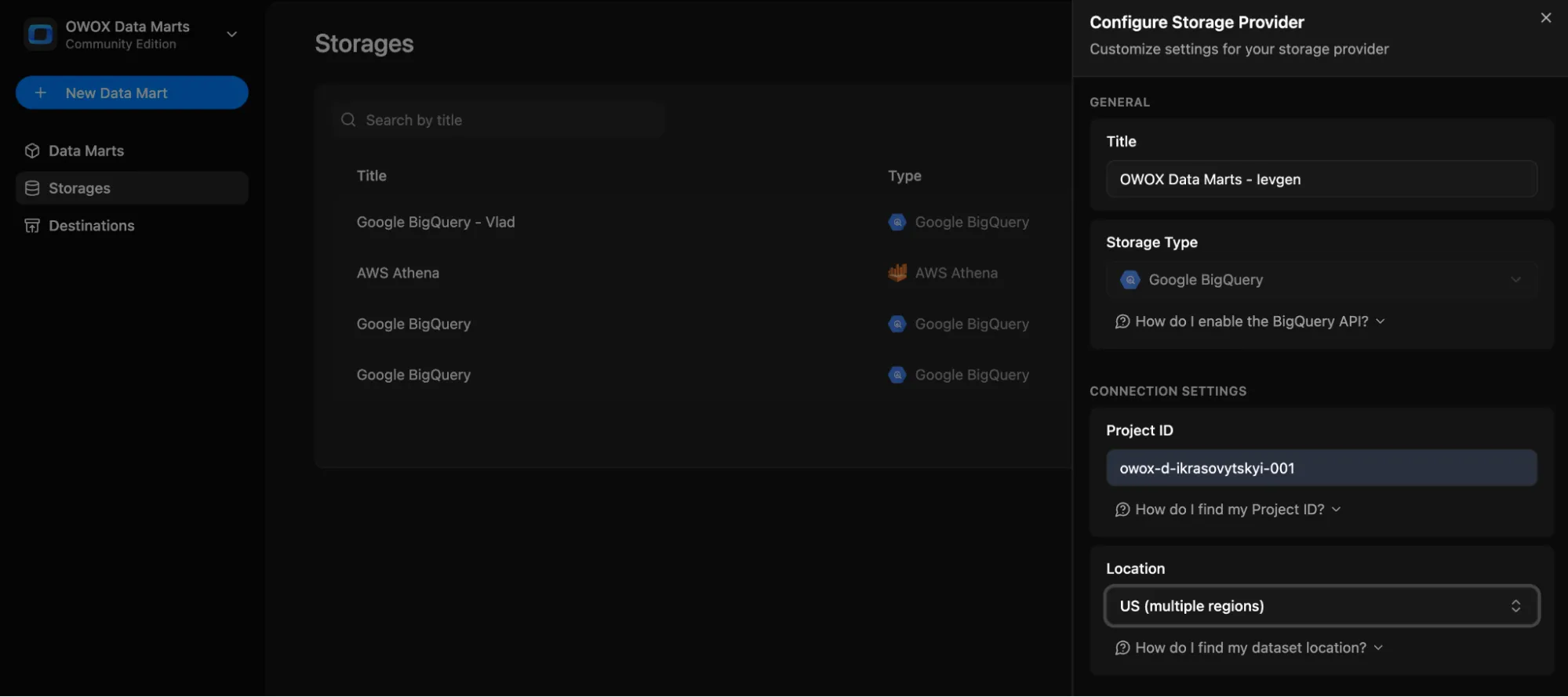
Select a Credential
Section titled “Select a Credential”The Credential field selects the key this Storage uses. The list shows the Credentials that fit BigQuery and that you can use. If exactly one fits a new Storage, it is selected for you. Click + Create new Credential to add one without leaving the form; the new Credential is selected when you save it. See Credentials.
OWOX Data Marts supports two kinds of BigQuery Credential:
Option A: Google Service Account (JSON Key)
Section titled “Option A: Google Service Account (JSON Key)”To get the JSON key, you’ll need to create or use an existing service account in Google Cloud.
✅ Best Practice: Always use a dedicated service account with least-privilege access for security and auditability.
How to obtain the service account key
Section titled “How to obtain the service account key”- Go to the Service Accounts page
- Navigate to IAM & Admin → Service Accounts
- Create a new account or choose an existing one
- Assign the roles:
BigQuery Data EditorBigQuery Job User
- Go to the Keys tab, click Add key → Create new key
- Choose JSON, click Create, and download the file
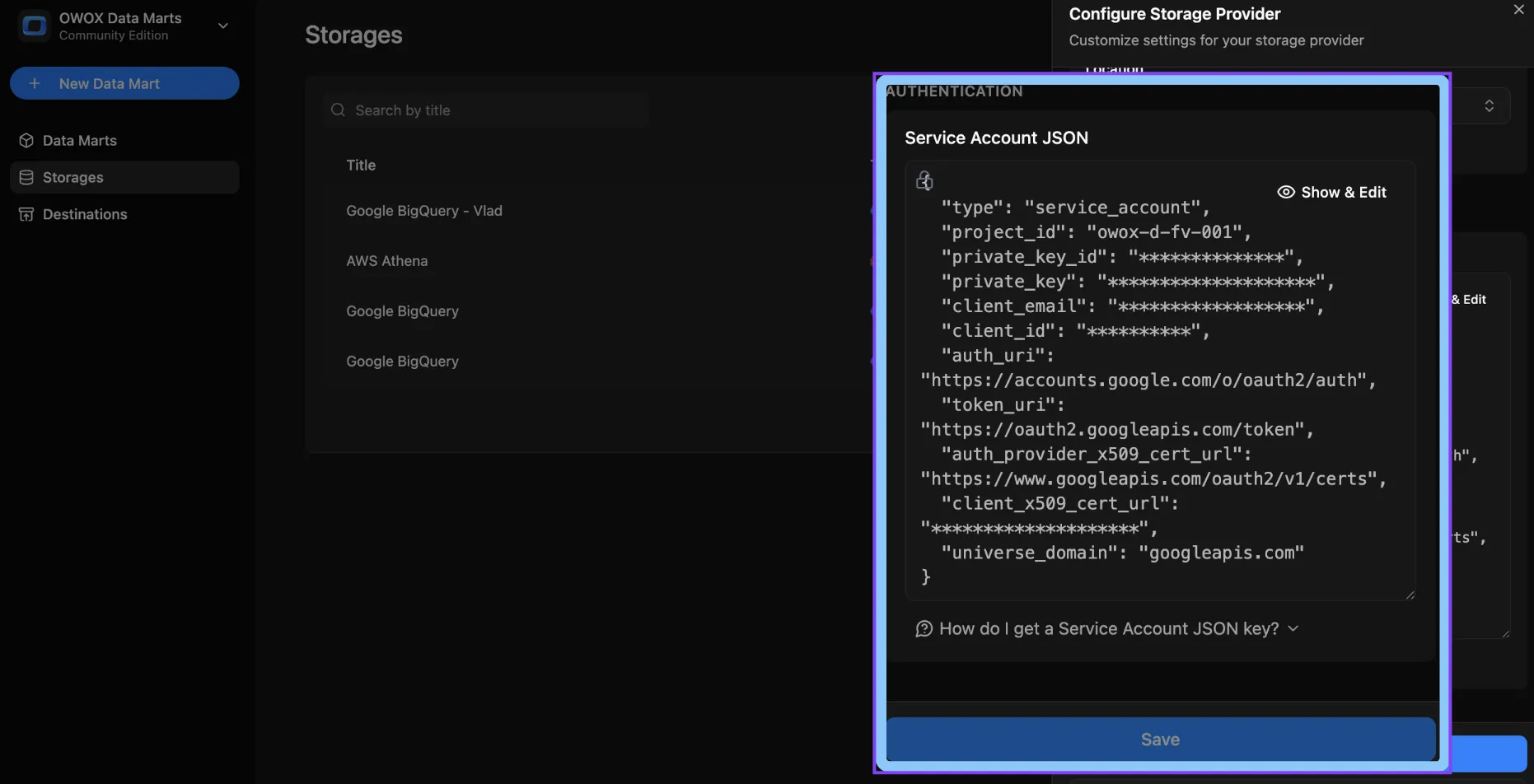
- In the Credential form, choose the Google Service Account provider, then copy the contents of the JSON file and paste it into the Service account key (JSON) field.
Paste the whole file: if the text is not valid JSON or has no
client_email, the field is highlighted with the reason when you click Save.
Option B: BigQuery Google account (OAuth)
Section titled “Option B: BigQuery Google account (OAuth)”In the Credential form, choose the BigQuery Google account provider and click Connect with Google. You will be redirected to Google’s consent screen to grant BigQuery access, and the Google account is linked to the Credential. The option appears only when Google OAuth is set up in your deployment.
Note: The authenticated Google account must have
BigQuery Data Editor(roles/bigquery.dataEditor) andBigQuery Job User(roles/bigquery.jobUser) roles in the target project. Check or assign these roles in IAM & Admin → IAM. OAuth tokens are automatically refreshed. If your session expires or access is revoked, open the Credential and click its Google button, Authenticated as or Connect with Google; every Storage that uses it works again.
Enable BigQuery API
Section titled “Enable BigQuery API”- Open the BigQuery API Library page
- Ensure the correct Google Cloud project is selected
- If the API isn’t enabled, click Enable
- If already enabled, you’ll see the API dashboard
5. Finalize Setup
Section titled “5. Finalize Setup”Review your entries and click Save to add the Storage configuration, or Cancel to exit without saving.